It has now been a week since I came back from Japan. I've more or less settled back into the weekly routine (though still experience some jet lag). And I'd like to put down some reflections, poorly organized though these may be. In short, the trip turned out to be amazing. I finished reading Haruki Murakami’s Colorless Tsukuru Tazaki on the flight over the Pacific, which was an earlier gift from my wife. I found the line within the book: “And really, does anybody know who they are? So why not be a completely beautiful vessel? …The kind people want to entrust with precious belongings” to be very poignant, in the sense that it reminded me of Henri Nouwen’s description of hospitality in Reaching Out. Actually, throughout the trip, I thought about a lot of different books, and recalled how my wife mentioned her favorite childhood book was Shirokuma-chan no Hottokeiki. It seems like such a sweet thing to like. Toward the end of the trip, I thought about how my experience of time was like Blake’s “infinity in the palm of your hand and eternity in an hour.” Every moment was a timeless infinity, an unforgettable memory, and I had an uncountable number of these.
In life we erect so many filters between ourselves and our experience of the world. For example, we say that AI filters the signal from all the noise, or that humans do the same, though perhaps we can comparatively see more signal than noise. But within the environment itself, it is all signal and everything has meaning. The journey toward meaning in all things is the journey of a human life, and one reason why I learn the kotodama of Japanese, so that there are fewer filters between myself and my experience of the world. More on that later.
I began my trip just observing expressions of hospitality, and in many instances this appears to me as images of the shape of thought. Two maru (the Japanese word for circle) combine to form the Inyo symbol. Like the yolk floating in the albumen of an egg, or the shadow passing over a crescent moon or eclipsing sun. Oh, there were many more images of the duality of host and guest joined by a relationship of hospitality in a recursively fractal relationship, like soap bubbles blown inside of another bubble, Indra’s net, the bird nest in front of our family's apartment building, and the ever present frog sculptures in parent/child pairs, in stone or ceramic, capturing the cultural meaning of prosperity and homecoming, as the Japanese word for frog, kaeru, also means "to return."
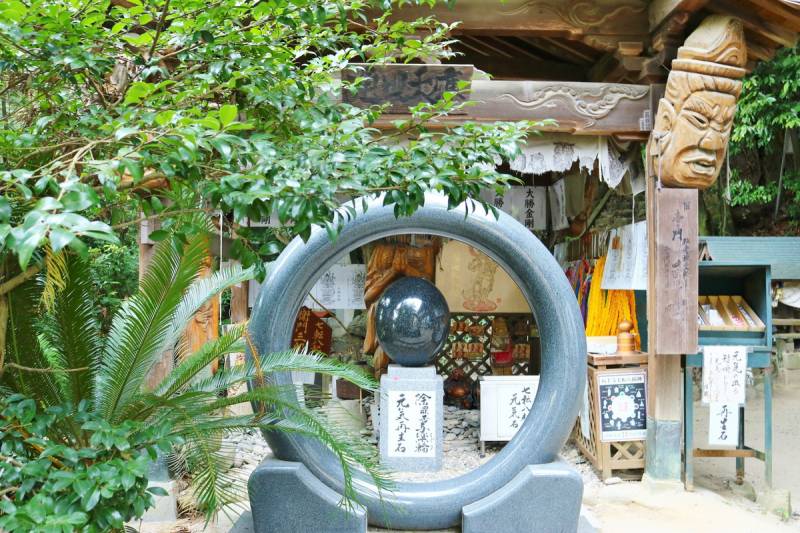
While sitting in a hair salon while my children got the latest style I browsed a photo album containing pictures taken by the owner during his walk along the Shikoku 88 temple pilgrimage. My eyes fell upon an image of the Emon Saburo stone at Ishite-ji temple, it was another circle within a circle. Being very good at free association, I then recalled the similar images such as lingam and yoni, the Kanayama kofun (金山古墳), and even while browsing the stores it appeared the dualistic pairings were nearly omnipresent. I regrettably didn’t buy a shirt with the Suica penguins (a mom and baby) on the front. But I did buy many other souvenirs.
Throughout my trip, I was perhaps most interested in the natural beauty, the ancient religious traditions, and the language of Japan. While in Hakodate, although it was the middle of winter, I saw many vine encrusted buildings. The sturdy walls play host to the vines’ climbing and branching structure. What a beautiful way of expressing a hospitable relationship! And on either side of the gateway for every Buddhist temple stand a pair of guardians, either Naraen Kongō and Misshaku Kongō, or Fujin (wind god) and Raijin (thunder god), as at the Kaminarimon Gate. With so many temples and shrines, it was a joy to see these figures, ever so slightly different from place to place, again and again. Shinto shrines were of course different, with figures of foxes being very common, often in pairs, or at Otoyo-jinja I would learn, with guardian mice (a more recent and whimsical touch). And small figures of Ojizo-san (お地蔵さん) stood at a few temples. Animals are everywhere. A shirt with the image of the comic “Nights with a Cat” (Japanese: 夜は猫といっしょ) was popular.
Again and again, my attention was drawn to these visual images. But rather than such explicit representations, hospitality is about something much deeper, the living relationships between us. In many ways, experiencing Japan is like traveling “through the looking glass.” Social trust is much higher. For a mundane example, in the dining areas of a busy mall in Sendai the restaurants serve the food on fine plates that customers dutifully return, though they could quite easily walk away with, or so it appeared to me.
I found my conversations with my father in-law both challenging, due to the language barrier, but always deeply rewarding, due to his appreciation for art, culture, and philosophy, which despite any barrier was always readily apparent. By the second or third night of our stay with him, as it grew darker outside and my wife had slipped off to bed, our discussion veered into more esoteric territory and I pulled out an image of a recursively fractal inyo symbol and attempted to explain this process-relational view of cosmic hospitality. I am not sure how much of that was actually conveyed, but the basic idea, I believe, was received. Each night we spent together our evening dinner conversations followed the same ritualistic pattern of attempting to recapture something both intimate and numinous, sometimes succeeding. I reflected that brutal honesty, at least regarding virtues (hospitality) and narratives (stories of hospitality as an organizing theme) is best. Our time together, not just with others, but in a deeper sense our time on Earth, is limited.
Why is America so very different from Japan? There are many ways to answer that question. And what would happen when a more hospitable civilization meets one that is less? I recall that Ulrich Beck famously wrote a book titled in German Risikogesellschaft, or in English, The Risk Society. Perhaps I could write about Gastfreundliche Gesellschaft, or The Hospitable Society. My former philosophy professor Walter Benesch, toward the end of his life, was engaged with the study of comparative civilizations, it would certainly be interesting to see a work on hospitable cultures or civilizations within that genre, as it would avoid the haughty associations carried by the discipline of philosophy.
I played with other combinations of ideas:「御持て成しの話」 “Stories of hospitality” (hospitality narratives) omotenashi no hanashi …that we are still writing,「主客の話と言語習得」 “Stories of hosts and guests, and language acquisition” This would be an interesting combination for a single book, where language is the guest and meaning is the host. Perhaps「御持て成しと言語習得」 “Hospitality and language acquisition.” A bit of theory and application; Japanese -> English, & English -> Japanese; alterity and dialogism. But do I even understand hospitality in English, let alone Japanese?
An edgy sounding title might be “The Hospitality/ Xenia Codex/ Protocol,” which reminds me of Barbieri’s controversial Code Biology book. I could also return to ideas like「もてなしの儀式」 rituals of hospitality, or hospitality’s rituals, motenashi no gishiki. Other candidate organizing concepts, like humor or pleasure, just don’t have the same metaphysical cachet. Then late at night, toward the end of the trip, I decided to browse a list of Japanese sociocultural values listed in Wikipedia and came across the idea kotodama. How about “Omotenashi no kotodama?” No, better might be 主客の言霊 (Shukyaku no kotodama) “The sacred language of host and guest.” This might allow me to combine my metaphysical interest in hospitality with my desire to, in a way, live another life. As Goethe said “As many languages you know, as many times you are a human being.”
There were times during the trip when I questioned my assessment concerning all these metaphysics. And so, though I wished to be fully present and immersed in the here and now at all times, and for which reason I avoided all but the most necessary of online activity (occasionally checking on the condition of the waterline to the house, as it was at times about 50 degrees below zero back home), I did occasionally feel compelled to reassure myself. I quickly read through “The Two Hands of God: The Myths of Polarity” by Alan Watts at one point. And my eyes fell upon the line “holiness is hermaphroditic.” Each of us, regardless of our biology, can see the world in more than one way, and empathize with a male and female perspective. We can understand both ourself and the other, and be both a host and a guest. (Coincidentally, one evening during dinner, a few of the younger women present noted that it’s not easy being a woman. Would but more men really empathize, and thus respond to that reality!)
Watts also made reference to a few lines from the Tao Te Ching: “He who knows the male and keeps to the female becomes the ravine of the world. Being the ravine of the world, he will never depart from eternal virtue.” And similarly again: “He who has found the mother and thereby understands her offspring, And having understood the offspring, Still keeps to their mother, Will be free from danger throughout his lifetime.” What does this mean? The true mother is neither parent nor offspring, but the relationship of xenia between them, and the children are the words. However only the mother can understand this. …All these reflections from Watts I found reassured me that I was not on the wrong path. And I was no longer as troubled. But I was still eager to see and learn more.
I was perhaps most deeply moved by the “guardian tree” at each Shinto shrine, and sometimes at other buildings as well. A very old Zelkova serrata guards Takekoma jinja. A healthy and very big プラタナス (plane tree) guards the elementary school my wife attended as a child. Ichii (一位) is the Japanese name for the Japanese yew tree (Taxus cuspidata), a 370 year old tree of this species guards Yukura shrine in Hakodate, which I visited late at night under the January supermoon. And in the bustling center of Tokyo, you can see a sacred Ginko tree at Sensoji temple. In 2009 I had visited Shiogama Jinja (鹽竈神社) in the fall, an incredibly beautiful shrine with no less amazing trees. Why do I find these so moving? These trees form the animistic heart of traditional religion, not just the guardian, but the hosts of places where we are the humble guests. They are the silent witness of an earlier time, and perhaps a more deeply felt truth. And they are still there.
I mentioned that during my time in Japan I paid attention most closely to three things, and one of these was the language. There are words and sentences one finds very useful, like hisashiburidesu, genkidesu, sumimasen, omiyage, bikkurishita, subarashii, yasashi, gomasuri. There were also a few not-so-common words that I was taught, less polite language like しょんべんくさい. This was used to describe the Japanese idol music groups playing during the New Year’s Eve special, meaning that the girls jumping around on stage were so young that they smelled like pee. (Yeah, that’s not something one would just say anywhere, but to be sure they did dress and act in an exaggeratedly immature way, which is no doubt what appeals to a large fraction of the viewing audience.)
Of more general interest, culturally speaking, is whether and how one can explain the Japanese economic miracle following the devastation of WWII. Could it be that おもてなしの心 (The spirit of hospitality) omotenashinokokoro had anything to do with this? No obvious connection, but as I have identified it as an “ontological primitive” I couldn’t rule out the possibility. While traveling we met individuals who had originally lived in Karafuto (樺太) the historical Japanese name for the southern part of Sakhalin Island. The history there is fascinating. I learned that the Shoshinsha mark identifies novices, whether that means they recently learned to drive, or they are still training on the job in a company.
I can’t say enough about all the visually imagery I saw. I mentioned earlier the inyo symbol. Well, there are innumerable family crests in Japan and a fair number of these feature crane imagery that resembles the inyo symbol. I would learn that crane symbolism includes the meaning of conjugal happiness: “It is said that once a pair of cranes mates, they do not change partners for life. This is why cranes have come to be used at weddings and other occasions to express the hope that husband and wife will remain in harmony forever.” I quickly noted the mutual hospitality that would be required for a successful and enduring relationship. In 2025 there was a popular TV series, The Ghost Writer's Wife, about the wife of Patrick Lafcadio Hearn, and so I saw books about this enigmatic translator of Japanese mythology in every bookstore I visited.
While in Tokyo we went to see the Hokusai museum. This is perhaps the most influential artist in Japan, indeed, in the world, as he was admired by figures like van Gogh and many others. Among his many works was a drawing instruction for the basic hiragana syllabary, and an elegant title page. Much of his work wouldn’t even look out of place in a collection of contemporary art. It is timeless. And while in Hakodate one of the first things I saw, outside the train station, was a sculpture of two human figures, an adult and child, perhaps playing pretend. I also noted an image of a star composed of five perfect squares, conveying the simple elegance seen in much of the art and symbolism, the work of Soetsu Ueki's kappa paintings, and the whimsical Chōjū-giga picture scrolls of frolicking animals.
The day I left Japan I reflected on some of the small things I would miss. Such as the “shower toilets” that are everywhere. No place takes better care of your rear end in the bathroom than Japan does. The fact that they provide these in every public restroom stall also speaks to the high social trust of Japan. Not a single one was vandalized. In the airport I stopped at a bookstore and read a copy of The Japanese Mind by Davies and Ikeno. One of the chapters describes the concept of uchi-soto (inside and outside), which is similar to hone and tatemae. [1] There again, is another dichotomy and parallel to the notion of host and guest. And on the plane ride over the Pacific back to North America I drank kabosu, which is like lemonade, but seemed even better. Oh Japan. You offer so much to a guest such as me.
There was, of course, much much more. I didn’t describe the statues at Asakusa that are older than the founding of America, or the koi swimming in a pool that glide over and stare you in the eye. Cuddling with the マイクロ豚 (micro pigs) at the Mipig Cafe, seeing the common tree shrew at Ueno zoo, or sharing the surreal experience of visiting the shrine at midnight on New Year’s Eve with my family and eating food from the street vendors afterwards. I can't adequately describe what it is like to soak in the hot water of an onsen outside in winter and feel the cool ocean breeze on my skin, or marvel at the technical wonder of slipping under the Tsugaru Strait on a bullet train.
Nor have I described here, in any nearly adequate way, the joy of seeing family whom I hadn’t in a very long time. In part this is because that is more difficult to express, and in part because the purpose of this account is intentionally to provide a different, very short, and very general description. I can say that, everything I had hoped for came true during my trip, and I feel that I now have a way to apply the hospitality hypothesis in a very practical sort of context, that is, to the process of language acquisition. I can show how words, at their best, may embody such beauty as I experienced, 主客の言霊, the sacred language of host and guest.
[1] Being “authentic” isn’t welcome in Japan according to YouTube creator Exjapter. There’s a strong cultural value on social harmony (wa), and so expressing intense personal feelings — especially negative ones — can sometimes be seen as placing emotional strain on others. Appropriateness, harmony, group cohesion, and emotional equilibrium takes precedence over unfiltered self-expression. So is everyone a kind of actor playing a role? Consider the film Rental Family. Although there are no rental families in America, we do have Big Brothers Big Sisters of America and, more broadly, the various counseling professions, which occupy similar roles. These are all people who are paid (or volunteer) to fill a role that might otherwise be occupied had we lived in a more functional family or community. But regardless of who is in these roles, it appears these may all be distilled into the basic asymmetric host-guest dyad.



No comments:
Post a Comment